Showing posts with label 18th century. Show all posts

Wednesday, October 14, 2009

The Letters of John and Abigail Adams


From 1762 to 1801, John and Abigail Adams carried on a remarkable correspondence. Some 1100 letters between the two survive to this day, offering historians a treasure trove of insights into both the dramatic events that occurred during that period (the Revolution, early Republic, and Adams' own tumultuous presidency) and the more mundane aspects of everyday life in a colonial family.

But the Adams' weren't just any colonial couple. They were the ultimate power duo. Think FDR and Eleanor. Bill and Hillary. Barack and Michelle. Abigail Smith Adams was a remarkably well educated woman who was not afraid to voice her opinions.

One of her more famous letters, from March 31, 1776, admonished John--then a delegate at the Second Continental Congress and a staunch advocate of declaring independence from Britain--to consider the rights of women in the new republic:

...in the new code of laws which I suppose it will be necessary for you to make, I desire you would remember the ladies and be more generous and favorable to them than your ancestors.

Do not put such unlimited power into the hands of the husbands.

Remember, all men would be tyrants if they could. If particular care and attention is not paid to the ladies, we are determined to foment a rebellion, and will not hold ourselves bound by any laws in which we have no voice or representation.

As an early advocate of women's rights, Abigail Adams was ahead of her time on other issues as well. She opposition to slavery and was a supporter of equal education for boys and girls. During his terms as Vice-President and President, John Adams considered Abigail Adams to be his most trusted advisor.

The Massachusetts Historical Society maintains an excellent online archive of the Adams letters in their digital collection " The Adams Family Papers: An Electronic Archive."

The letters are fully indexed and can searched by date or keywords. Each letter contains a transcription as well as a digital image of the actual letter and envelope and an automatic citation generator. The perfect place for historians (both new and veteran) to begin research!



Friday, October 9, 2009

The Brown Bess


In the days of lace-ruffles, perukes, and brocade
Brown Bess was a partner whom none could despise --
An out-spoken, flinty-lipped, brazen-faced jade,
With a habit of looking men straight in the eyes --
At Blenheim and Ramillies, fops would confess
They were pierced to the heart by the charms of Brown Bess.

-- Rudyard Kipling


During the Revolutionary War, the standard issue firearm for both the American revolutionaries and the British military, was the barrel-loading flintlock musket. The actual "Brown Bess" refers to the Land Pattern Musket, produced in mass quantities by Britain in 1722. The name remains somewhat of a mystery, but may have been a reference to the walnut stocks (a rich brown color), the anti-rust treatment given to the barrels which resulted in a deep brown appearance to the gun, or a bastardization of the German phrase for strong gun: braun buss.

Although many adaptations were made to this weapon, the generic name "Brown Bess" has been applied generically to all muskets of this type used throughout the 18th century.

The weapon itself weighed nearly 10 pounds, and had limited accuracy, with a range of perhaps 100 yards. Moreover, the loading process was involved (as seen in the video above):

  • Bite the cartridge.
  • Push the frizzen forward to open the pan and pour a small amount of powder into the flash pan.
  • Snap the frizzen back to position covering the flash pan.
  • Hold the musket vertically so that the muzzle is up.
  • Pour the remaining powder down the barrel.
  • Insert the bullet in the barrel.
  • Push the cartridge paper into the barrel
  • Remove ramrod from pipe under the barrel and use to push wadding and bullet down the barrel.
  • Replace the ramrod.
  • Raise musket to firing position with the butt against the shoulder.
  • Pull back the hammer.
  • Aim and fire!
A well trained soldier could load and fire three shots per minute; some accounts suggest that Prussians could volley as many as five in that time...although that seems unlikely. Because of the time it takes to load, soldiers tended to fire in volley.

The video below illustrates how a well regimented soldier would follow commands precisely. Now imagine a line of these soldiers standing their ground while facing an opposing army, as the British did on Bunker Hill in 1775....


Tuesday, August 25, 2009

Today's Class: Primary Sources and Martha Ballard's Diary

Today's class was devoted to examining the concept of history. History is not the past, but rather an interpretation of the past based on an analysis of the source material left behind: diaries, records, artifacts, art, statistical data, etc. This is both a science and an art. A historian must be a sound research, but he or she must also possess creativity; it's the ability to look at sources in a new light or see a connection that was previously missed that makes for truly unique history.

Moreover, historians act as gatekeepers of our memory. They, in large part, determine what is significant enough to pass on (and what get's relegated to the "dustbin of history), and it's their skilled analysis of source material that crafts the narrative that we accept as our nations story.

Because historians don't exist in a vacuum, they too carry with them their personal, cultural, and political biases. As a result, there can be significant disagreement among historical interpretations. Furthermore, historical understandings change with the times. In the early 1800s, historians largely ignored the contributions of women or African-Americans; by the 1970s, new research was painting a more complete picture of the lives of minorities and how those experiences contributed to our collective history.

Working with source material (the "raw stuff" of history) is both a joy and a challenge for students. Source material is unfiltered, and therefore more real, and often far more interesting than the Wonder Bread version of history found in most high school textbooks. But it asks more of the student. Rather than giving the answers, sources force students to draw their own conclusions. And sometimes, those sources are just plain hard to read.

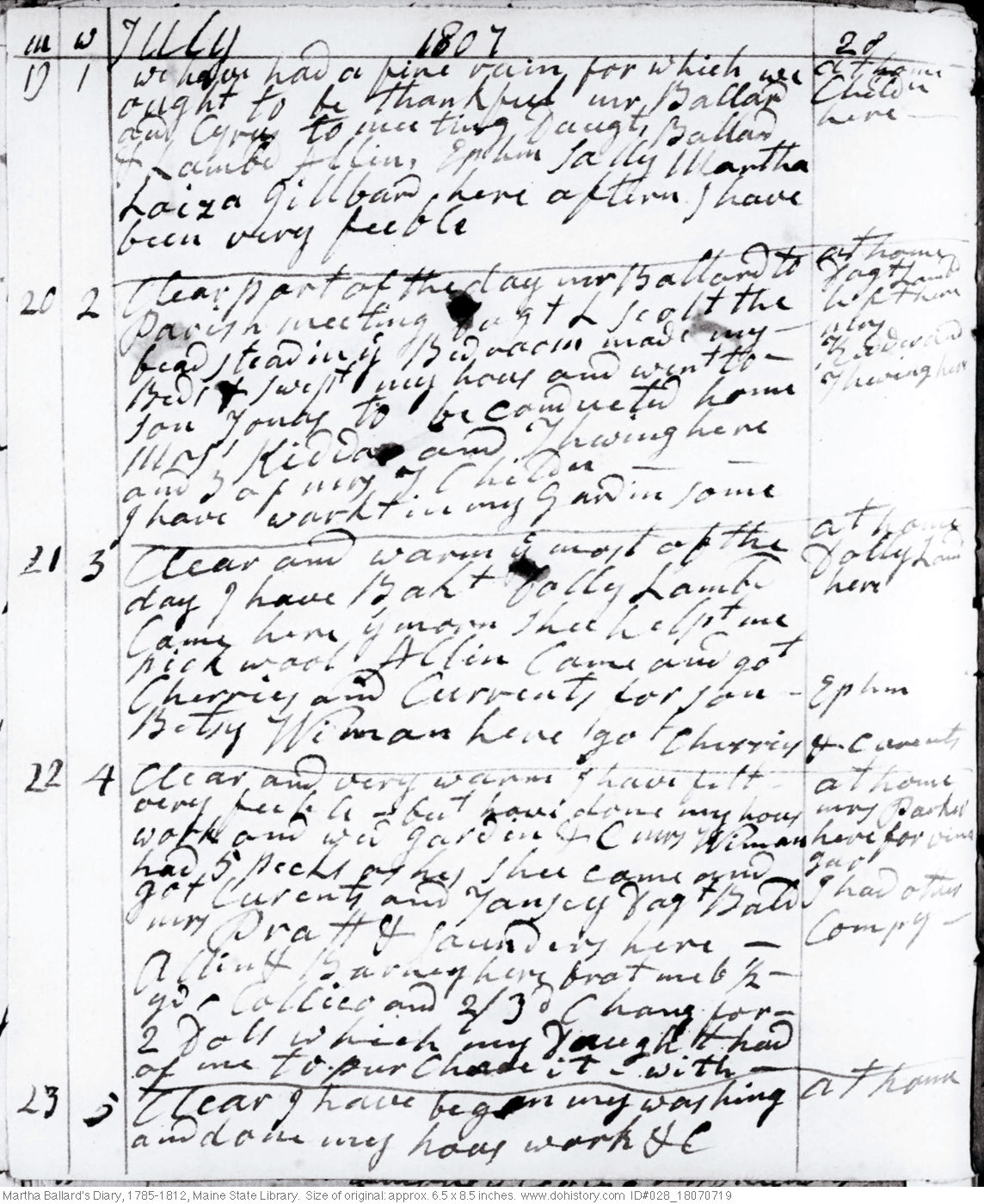
We looked at an example today in class: the diary of Martha Ballard.

Martha Ballard was a midwife in Oxford, Maine in the late 17th century. She performed over 816 deliveries between 1785 and 1812. She kept a detailed diary that was discovered by historian Laurel Thatcher Ulrich and became the basis for the book A Midwife's Tale (Vintage Books, 1991). As Dohistory.org (a website created through a joint venture with Harvard University and George Mason University) points out, through Martha Ballard's diary

"we can learn a great deal about her life as a healer and midwife, mother and wife. We come to realize that Martha Ballard was a respected member of the community, depended upon by the inhabitants of Hallowell, Maine from 1785 until her death in 1812. Through her diary, we can also glimpse the lives of the town's other inhabitants--the ordinary people who are normally invisible to us when we look back into the past. Her diary enriches, deepens, and complicates our understanding of everyday life in early America."
One of the challenges, however, is merely deciphering Ballard's handwriting. In order to understand Ballard's story, Ulrich had to not only learn to read Ballard's writing, but also decode her unique forms of phonetic spelling, dating, accounting and abbreviation used throughout the diary.

As an activity in class, students tried their hand at transcribing a page from the Ballard diary, without much luck (9th period came the closest!). The selection we decoded cryptically referred to a Mrs. Foster, who apparently was on being "abused by unknown persons" who attacked her home with stones.

For the budding young historians who want to know "why," the link to the page in diary is here, so you can continue decoding.

Or, if you want a quicker way of finding out the controversy that Mrs. Foster was caught up in, click here to view a 5-minute video in which historian Laurel Thatcher Ulrich explains the episode. It's an instructive look at how one's gender and socioeconomic class play a role in how justice is carried out.