
Today's class was devoted to examining the
concept of history. History is not
the past, but rather an
interpretation of the past based on an analysis of the source material left behind: diaries, records, artifacts, art, statistical data, etc. This is both a science and an art. A historian must be a sound research, but he or she must also possess creativity; it's the ability to look at sources in a new light or see a connection that was previously missed that makes for truly unique history.
Moreover, historians act as gatekeepers of our memory. They, in large part, determine what is significant enough to pass on (and what get's relegated to the "dustbin of history), and it's their skilled analysis of source material that crafts the narrative that we accept as our nations story.
Because historians don't exist in a vacuum, they too carry with them their personal, cultural, and political biases. As a result, there can be significant disagreement among historical interpretations. Furthermore, historical understandings change with the times. In the early 1800s, historians largely ignored the contributions of women or African-Americans; by the 1970s, new research was painting a more complete picture of the lives of minorities and how those experiences contributed to our collective history.
Working with source material (the "raw stuff" of history) is both a joy and a challenge for students. Source material is unfiltered, and therefore more real, and often far more interesting than the Wonder Bread version of history found in most high school textbooks. But it asks more of the student. Rather than giving the answers, sources force students to draw their own conclusions. And sometimes, those sources are just plain hard to read.
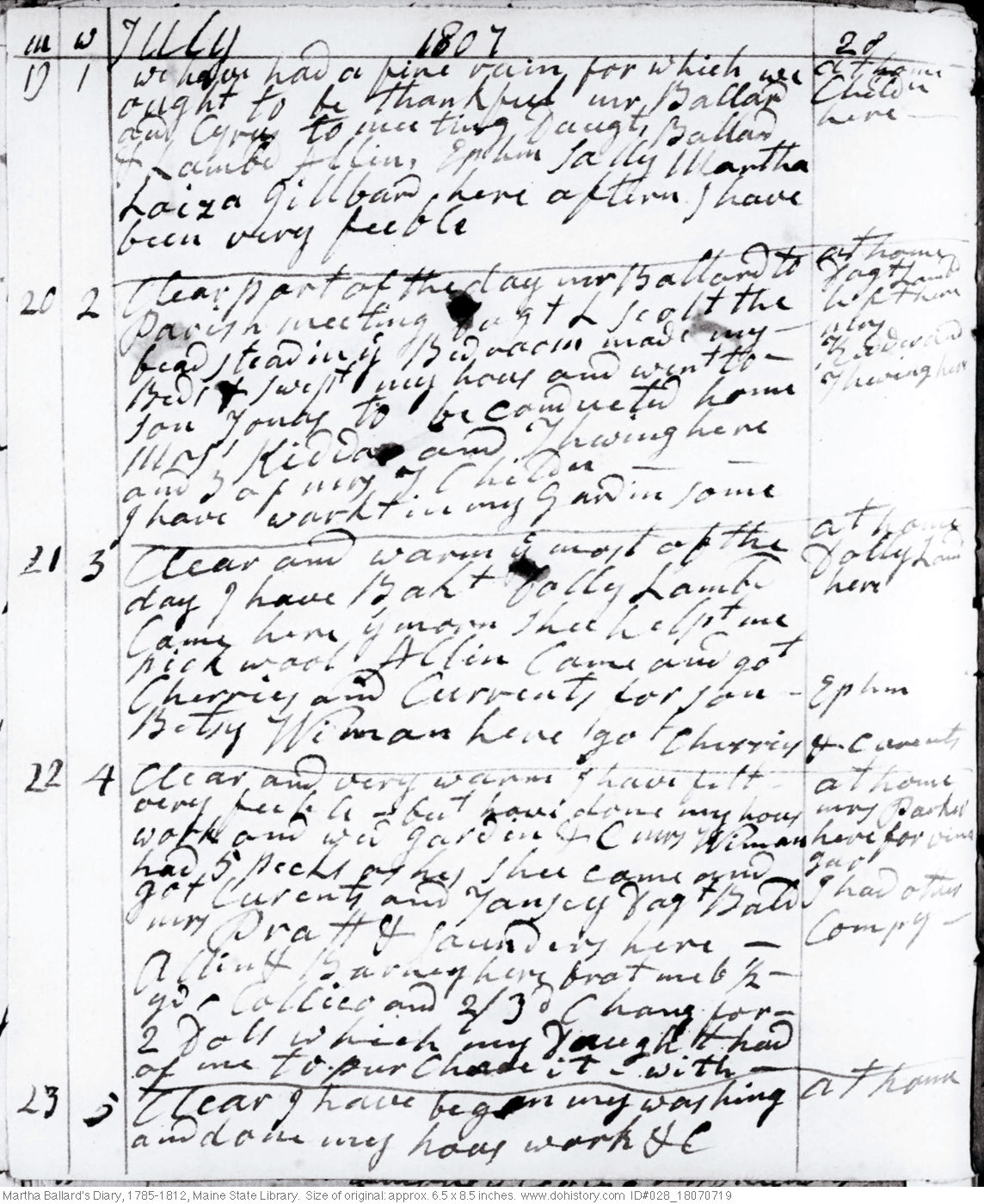
We looked at an example today in class: the diary of Martha Ballard.
Martha Ballard was a midwife in Oxford, Maine in the late 17th century. She performed over 816 deliveries between 1785 and 1812. She kept a detailed diary that was discovered by historian Laurel Thatcher Ulrich and became the basis for the book
A Midwife's Tale (Vintage Books, 1991). As Dohistory.org (a website created through a joint venture with Harvard University and George Mason University) points out, through Martha Ballard's diary
"we can learn a great deal about her life as a healer and midwife, mother and wife. We come to realize that Martha Ballard was a respected member of the community, depended upon by the inhabitants of Hallowell, Maine from 1785 until her death in 1812. Through her diary, we can also glimpse the lives of the town's other inhabitants--the ordinary people who are normally invisible to us when we look back into the past. Her diary enriches, deepens, and complicates our understanding of everyday life in early America."
One of the challenges, however, is merely deciphering Ballard's handwriting. In order to understand Ballard's story, Ulrich had to not only learn to read Ballard's writing, but also decode her unique forms of
phonetic spelling, dating, accounting and abbreviation used throughout the diary.
As an activity in class, students tried their hand at transcribing a page from the Ballard diary, without much luck (9th period came the closest!). The selection we decoded cryptically referred to a Mrs. Foster, who apparently was on being "abused by unknown persons" who attacked her home with stones.
For the budding young historians who want to know "why,"
the link to the page in diary is here, so you can continue decoding.
Or, if you want a quicker way of finding out the controversy that Mrs. Foster was caught up in,
click here to view a 5-minute video in which historian Laurel Thatcher Ulrich explains the episode. It's an instructive look at how one's gender and socioeconomic class play a role in how justice is carried out.

 Among other controversial weapons of the Vietnam era (e.g., napalm and the defoliant Agent Orange), the US deployed "cluster bombs." A cluster bomb was actually a 1,000 to 2,000 lb . canister containing hundreds of smaller bomblets. The canister opened in mid-flight, spreading the bomblets out to maximize the destructive capacity of the weapon.

 Posts
Posts

